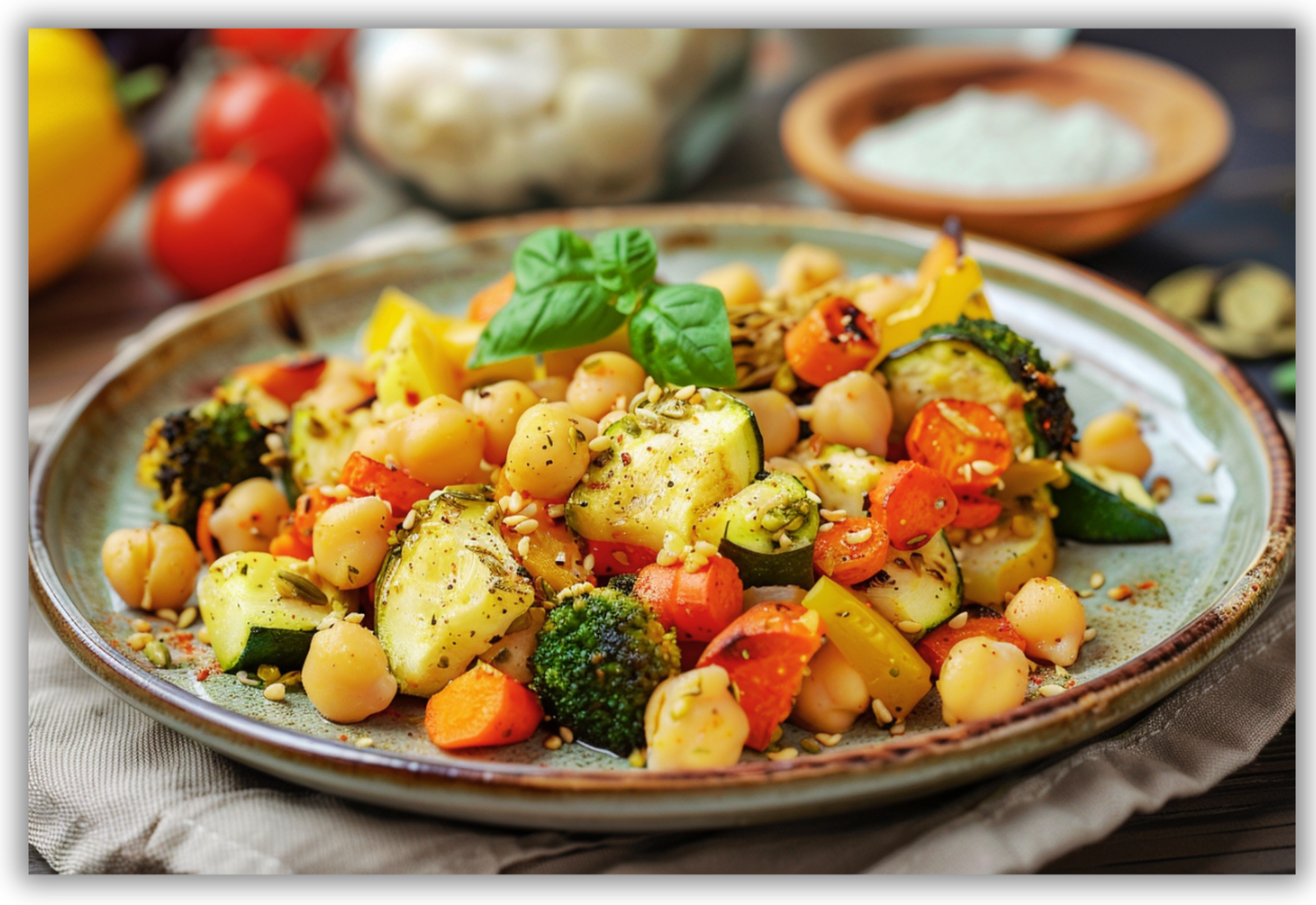
Roasted Vegetables with Warm Chickpeas and Tahini
A warm, grounding plate for steady satiety and calm nourishment
A Second Shared Meal
This is not a dish meant to impress.
It is a dish meant to hold.
Roasted vegetables, chickpeas, and tahini come together in a warm, balanced plate that supports satiety without heaviness.
Familiar and adaptable, it offers nourishment without urgency and structure without demand.
It meets the moment without asking more.
Why This Works
• Vegetables provide volume and fiber that support digestion
• Chickpeas contribute plant-based protein and steady energy
• Tahini adds fats and minerals that enhance satiety and absorption
The effect comes from balance, not complexity.
Ingredients
Ingredients (serves 2)
• Mixed vegetables (zucchini, carrots, fennel, broccoli, or what is available)
• 1 can chickpeas, rinsed and drained
• 1 tablespoon extra-virgin olive oil
• Sea salt
• 2 tablespoons tahini
• Lemon juice, to taste
• Water, to thin the sauce
This plate works best when flexibility is preserved.
Nothing essential needs to be added.
Preparation
Roast the vegetables with olive oil and a pinch of sea salt until tender and lightly caramelized.
Warm the chickpeas gently in a small pan over low heat.
In a separate bowl, whisk the tahini with lemon juice and enough water to create a smooth, pourable sauce.
Assemble the vegetables and chickpeas together, drizzle with the tahini sauce, and serve warm.
This is food that adapts.
It does not demand perfection.
Serving
Serve warm, in a shared moment.
This dish invites slowing down.
It does not require precision.
The warmth is steady, not overwhelming.
The flavors are present, not loud.
This is a meal that creates space.
No need to elevate it.
No need to perfect it.
Just sit, and let it do its work.
Why These Meals Matter
These meals are not remarkable in isolation.
Their power lies in repetition and context.
They are easy to return to. They invite sitting down. They leave space for conversation.
Over time, meals like these begin to reshape how the body responds — not dramatically, but reliably.
Stability replaces urgency.
Connection replaces control.
The shift is subtle but cumulative.
When the table becomes a place of regulation rather than distraction, the nervous system begins to expect calm instead of stimulation.
And expectation shapes physiology.