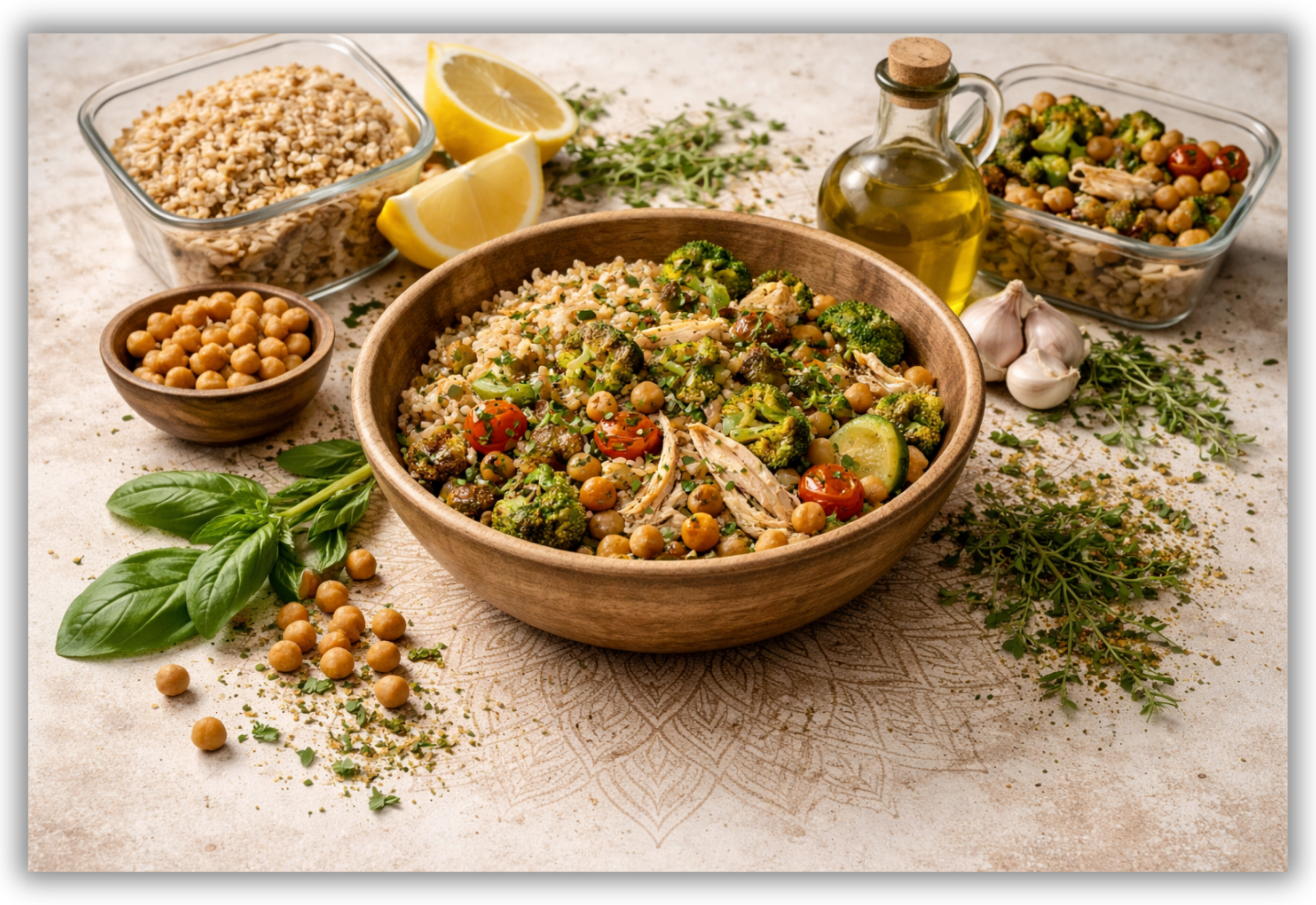
Leftover Bowl with
Whatever Is Available
A quiet bowl that keeps nourishment moving
INTRO
One-Bowl Balanced Plate
This is the quiet teacher.
It reminds the body
that nothing needs
to restart.
What is already there
can still be enough.
Why This Works
• Leftovers retain nutritional value
• Vegetables restore balance
• Olive oil creates cohesion
Continuity is anti-inflammatory.
Ingredients
Ingredients (serves 1-2)
• Leftover grains, legumes, or proteins
• Any available vegetables
• Olive oil
• Sea salt
The body trusts what returns.
Preparation
Start with what is already cooked.
Choose any leftover grains,
legumes, or proteins
that are still good to use.
Warm olive oil
in a pan over low heat
for about 1 minute,
just until fluid.
Add the vegetables,
cut into small, even pieces,
and cook gently
for about 4–5 minutes,
stirring occasionally,
until just tender
but still holding structure.
Add the leftovers
and combine gently.
Warm everything together
for about 2–3 minutes,
loosening the texture
without pressing or compacting it.
If needed,
add a small splash of water
to keep the bowl soft and light.
Remove from heat
and let it rest
for about 1 minute.
Transfer to a bowl.
Finish with a drizzle
of olive oil
and a pinch of sea salt.
If available,
add fresh herbs or seeds
just before serving.
Serving
Eat calmly.
This meal rewards practicality.
Let the bowl feel enough
without asking it
to become something else.
Why These Meals Matter
Love rarely disappears all at once.
More often,
it fades through accumulation.
Accumulated tension.
Accumulated noise.
Accumulated vigilance.
The body stays busy
long after the day ends.
In that state,
intimacy does not vanish.
It waits.
Evenings matter
not for what we add,
but for what we allow to stop.
Meals that are too heavy,
too fast,
or too complex
keep the body working
when it should be releasing.
Meals that are warm,
gentle,
and shared
send a different signal:
You can soften now.
This is why continuity matters.
Not because it is exciting,
but because it is regulating.
A bowl like this
reduces effort,
removes performance,
and gives the body
something familiar to receive.
Sometimes,
that is where openness begins.
Not with intensity.
With recognition.
Nutritional Overview (per serving – estimated)
Calories: ~350–420 kcal
A flexible, steady energy load that adapts to what is available
Fat: ~16–22 g
Primarily from olive oil and retained fats in leftovers; supports satiety
Carbohydrates: ~30–40 g
Varies depending on grains or legumes included; generally complex
Protein: ~12–22 g
Highly variable; depends on legumes, eggs, fish, or meat
Sugar: ~3–6 g
Naturally occurring from vegetables; no added sugars
Sodium: ~300–500 mg
Low to moderate; depends on leftovers and seasoning
Potassium: ~600–850 mg
Often substantial due to vegetables and legumes
Cholesterol: ~0–90 mg
Varies by protein choice; absent if fully plant-based
Glycemic Index:
Low to moderate (estimated), depending on grain and protein composition
Allergens:
Variable; may include gluten, legumes, fish, eggs, or dairy depending on leftovers used
Health Benefits:
• Supports metabolic and nervous system regulation through continuity
• Reduces decision fatigue and stress around meals
• Encourages adequate nourishment without performance pressure
• Aligns with anti-inflammatory eating patterns focused on consistency rather than precision
Provides a reliable share of daily energy and nutrients while reinforcing a central principle of the book: the body responds best to what it recognizes and repeats.